

This is a rarely discussed issue which is becoming increasingly visible among Indian Christians. As children grow, many choose a different faith practise from their parents. They stay away from church, question the dogmas that their parents took for granted, or marry outside the faith community.
Reshaping of identity at adolescence:
From the psychological viewpoint this is a consequence of the churn and re-shaping of the individual’s identity that happens in adolescence and early adulthood. This is an inevitable process, which every adult Christian can see, in hindsight, during their own teens and early twenties. It may have led to big or small departures from the faith of their parents.
Adolescence is a time when young persons face many challenges and life-changes. Their minds are growing into their full potential, with concrete thinking giving way to complicated and abstract thinking. Their academic lives are often demanding; they must decide which discipline and career to pursue. This is closely linked to pondering the meaning and purpose of existence, in general and their own, and searching for a credible explanation for life’s complexities. Simultaneously, their bodies are changing, growing into mature adulthood, bringing in associated issues and choices of sexuality and relationships. Their family life is also possibly facing crises such as illness and loss of older family members. Young persons at this stage have to make sense of all this and create an identity for themselves which organises their life choices, helps them navigate life, and also sets them apart as unique individuals, not just their parents’ child. This identity may not necessarily be the same as the identity conferred on them at birth. The primary psychological task of adolescence is to choose who they want to be, and which group of people they identify with most, and how much.
How does this happen?
This happens via conscious and unconscious processes in the person’s mind as he or she goes through cycles of exploration, evaluation and commitment to one or other facet of their identity, whether faith, other beliefs (for example, choosing to be vegan), country or community identity, career choices, relationship choices, orientation and so on.
Depending on the strength of their exploration and the ability to commit to these identity markers, the person may develop a weak, diffuse identity (with low exploration of the issues involved and low commitment to any of the identity markers), shallow identity (low exploration with strong commitment), be in a suspended moratorium state (high exploration with low commitment), or finally have a firm and stable achievement of identity (high exploration with high commitment).
Christian parents, of course, would hope their adult children would achieve the last mentioned form of faith identity – where their child has explored in depth all issues regarding faith and has come to a point of firm commitment to the faith, in the same terms they have. It would be wise to remember, however, that there is a bound to be some change, and the children will never have exactly the same position as the parents did, on issues of faith.
Why do some adult children move away from faith?
All young people form their own understanding of faith as part of their identity formation. The distance they travel from their parental faith is based on the interplay of many factors. Critical thinking is an important factor, and is the reason why those encouraged to think and analyse everything may also analyse religious faith more than others. If there is cognitive dissonance between what their faith teaches, and other inputs, their final commitment to faith may be weaker than formerly. Frequent examples are the dissonance many science students undergo when told by the church that evolution is false, based on a strict six-day-creation reading of scripture, or that experienced by arts students if the church insists that racism does not exist as a structural or systemic problem, but is purely an individual sin. The cognitive dissonance would naturally be more when parents or church also present poor role models of Christian life, where their teaching and praxis do not go together, such as a parent or Sunday school teacher who talks about God’s love or honesty while also exhibiting a frequent foul temper or giving bribes. If the young person has exposure to people outside the church whose philosophy and praxis are more together, even if they are not Christian, they may conclude that faith itself is futile. There is also considerable peer pressure on young people in the area of religious faith, as most of their friends may be agnostic or shallow believers, and standing out in this area may be embarrassing for the young person. This is the time of initial romantic awakening; it can influence their own development of faith if their person of interest is irreligious. Circumstances such as undergoing abuse, or facing grief or loss of a loved one, or seeing their families struggle may also make them question if God really exists, or cares. Finally their own personality traits such as ambitiousness or independence, may make it difficult to accept faith, simplicity, trust, service and obedience as a way of life.
Biblical inputs and what Christian parents can do:
As Christians try to understand why this shift occurs, it is important to see how God views it, and formulate Biblical principles that will guide our understanding, our pro-active preparation for adolescent children and our reactions when they question faith.
First, we see God Himself, in the first three chapters of Genesis granting humans free will, as a consequence of being His image-bearers. This gave humans immense dignity and worth, but also included the possibility, and ability to make wrong choices. We see the same possibility and freely made choice in Jesus’ parable of the prodigal son. The father allows the son to make a foolish choice. Parents need to accept the children have the same freedom, and treat them with respect, whatever they say, question or reject.
Yet, God retains the same love and care for humans before and after their wrong or unwise choices. He didn’t blast Adam and Eve into oblivion. Nor does the prodigal’s father yell and rant at him. They are rather, grieved, but loving and caring still. God makes provision for human salvation even as He tells Adam and Eve the result of their sin. The father runs to meet the son and embraces him. Christian parents must follow God’s example. Our love and concern for the child stepping away from faith must remain the same, no matter how much we grieve. There is no place for rage, attempts to control, emotional blackmail or withdrawing, refusing to discuss the issue or cutting off the child.
The Biblical injunctions to parents are to lovingly teach and bring them up in the faith (Eph 6:4), training them in the way they should live (Prov 22; 6), while not frustrating them. This kind of wise authoritative parenting, high on responsiveness to the child’s needs and emotions, as well as high on teaching excellence, is one of the most important inputs into a child’s life. Parenting needs to be pro-active; in particular, in this issue, preparing the child for peer pressure, and using God’s guidance to gently correct facets of the child’s personality that make it difficult for them to obey God.
God expects us to think and be wise and knowledgeable people. Being made in His image (Gen 1: 28-30) in itself implies God’s gracious granting of rational thought to humans alone among all His creatures, along with the ability to choose and feel. Proverbs is full of verses encouraging believers to seek wisdom, knowledge and understanding (Prov 2: 1-6, for example), beginning, of course with the fear of the Lord (Prov 1:7). All this implies an active involvement of one’s rational mind, and critical thought processes in all areas. In Philippians 4:8, Paul urges his listeners to think about all that is excellent, good, right, noble and pleasing to God – and this really, would include so many things about the world that God created and declared to be very good. Romans 12: 1 and 2 has another interesting call. It is not to keep away from thinking for fear one would lose one’s faith, or that is blasphemy to think and question. Rather, his call is to think with minds illuminated and transformed by Christ.
Christian parents, therefore, should encourage their children to learn and study, to think critically and analyse and question issues as they learn and grow, because there is nothing to fear in that. Wisdom and rationality are God’s gift to his image-bearers. The Christian faith can stand upto scrutiny and critique. There is no need, similarly, to reduce their exposure to new ideas or people, for fear of them losing their faith.
What is important however, is to ensure that neither the parents, nor the children, suffer cognitive dissonance in their teaching and praxis, that can put thinking people off faith. The usual culprits here are interpretations of Scripture that go against science, or common sense, or the social norms of kindness, equality and inclusivity (which stem from God Himself). For instance there was a time when the church insisted that the earth was the centre of the solar system, and universe, based on a literal reading of Genesis 1 – a stance that would surely cause severe doubting of the faith if parents were to insist on that teaching today!! That interpretation has thankfully been consigned to the dust-bin, but there are other interpretations of scripture that are still popular, which fly in the face of what science has discovered, or social science advocates. While these can be complicated questions, with difficult to interpret scriptural texts, Christian parents who take rigid stances on these are creating situations where the children are forced to choose between the parents’ version of truth and the version of the rest of the world. It would be wise, in such instances, to hold opinions tentatively, listen to others, re-examine scripture honestly and humbly, or agree to disagree without making it a make-or-break issue. Some issues causing cognitive dissonance in adult children due to rigid positions of parents or the church are the equality of men and women, leadership roles for women, acceptance of the LGBTQ community, abortion, the problem of war and pacifism, the issue of guns and violence, the problem of caste and racial purity and discrimination, marrying within the community and so on.
While dealing with these and other issues, such as difficult circumstances, God expects believers to set examples of holy and faithful Christian witness, following Christ (Eph 5:1), showing faith, trust, kindness, humility, gentleness, love and so on in how they speak, react to tragedies, or loss, or betrayal, in how they listen to questions or accusations, perhaps change, perhaps humbly seek forgiveness and so on. Further, every Christian should be able to tell their children, or those they disciple, to follow them, as Paul did, (I Corinthians 11: 1) because they are truly following Christ in growing and living faith. This is often what can give adolescents and young adults hope in the faith, because even if they see problems within the wider church, they can see God at work in their parents’ or mentor’s life, in their teaching as well as their living out their faith in hard times.
Finally, the Biblical principle of hoping and trusting God must not be forgotten (Psalm 37: 3-5,
Jer 17:7,8). Just as the prodigal’s father knew the pain of a wilful child,(Luke 15: 11-31) so God knows the same pain, but in Christ, He wins them back to Himself (2 Cor : 18-20). He promises to hear and answer prayers made in His name (Matthew 7: 7-11, John 15:16). Christian parents then must keep channels open to continue to talk to their adult children about faith and as they pray, they can hope and trust as they trained up their child in the right way, he will not depart from it when he is old, even if his journey back to Christ takes a while.
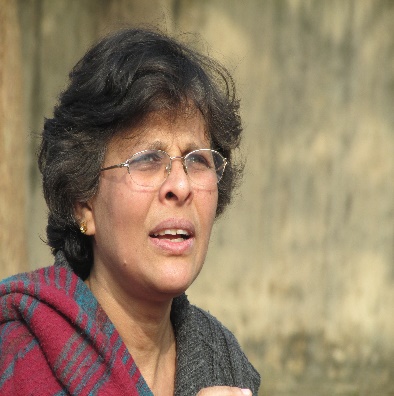
Dr. Jamila Koshy is a psychiatrist in practice. She graduated with an MBBS from the Armed Forces Medical College (AFMC), Pune and completed her post-graduate studies in Psychological Medicine from the University of Bombay. She has served in the Indian Army. Jamila has contributed to many books and journals. The books “Side by Side” (SAIACS Press), “Talking Families”, “Should I Care?”(ISPCK, Delhi) and Public Theology: Exploring Expressions of the Christian Faith (Primalogue & TRACI) are part of the initiative in group writing on issues of contemporary concern.